
Danish perfumery is recent enough that most of it has happened in the last fifteen years. There is no long tradition here of the kind France has. What there is instead is a design culture that arrived first and set the terms.
Why it looks the way it does
Danish design has spent a century arguing for restraint: fewer elements, honest materials, nothing decorative that is not also structural. When perfume houses started here, they inherited that argument rather than the French one.
In practice that means compositions with fewer materials, projection kept deliberately close, and a general suspicion of anything that announces itself. It also means a lot of Danish fragrance reads as understated to people expecting perfume to be a statement.
The light problem
Denmark gets very little daylight for a large part of the year, and quite a lot for a short part of it. That does more to shape what people want to wear than any trend does.
Winter here pushes towards warmth: resins, vanilla, woods, things that sit close and do not evaporate the moment you step outside. Summer swings the other way, towards green and marine and anything that feels like air.
Houses that make one fragrance for the whole year are ignoring half the calendar.
Small by choice
The economics matter. Denmark is a small market and Danish production costs are high, which rules out competing on price. What is left is making a small number of things properly and selling them to people who care about the difference.
That has a side effect worth naming: a small house cannot afford an unhappy customer. When you make five fragrances rather than fifty, every one of them has to justify itself, and there is nowhere to hide a weak one.
What is actually in Danish fragrances
Some recurring materials, and they are not accidental.
Sea salt and mineral notes, because nowhere in Denmark is far from the coast. Green and grassy notes, which are less about spring flowers than about wet fields. Birch, pine and soft woods. And a fondness for musks, which do the close, skin-adjacent work that suits a culture uncomfortable with being loud.
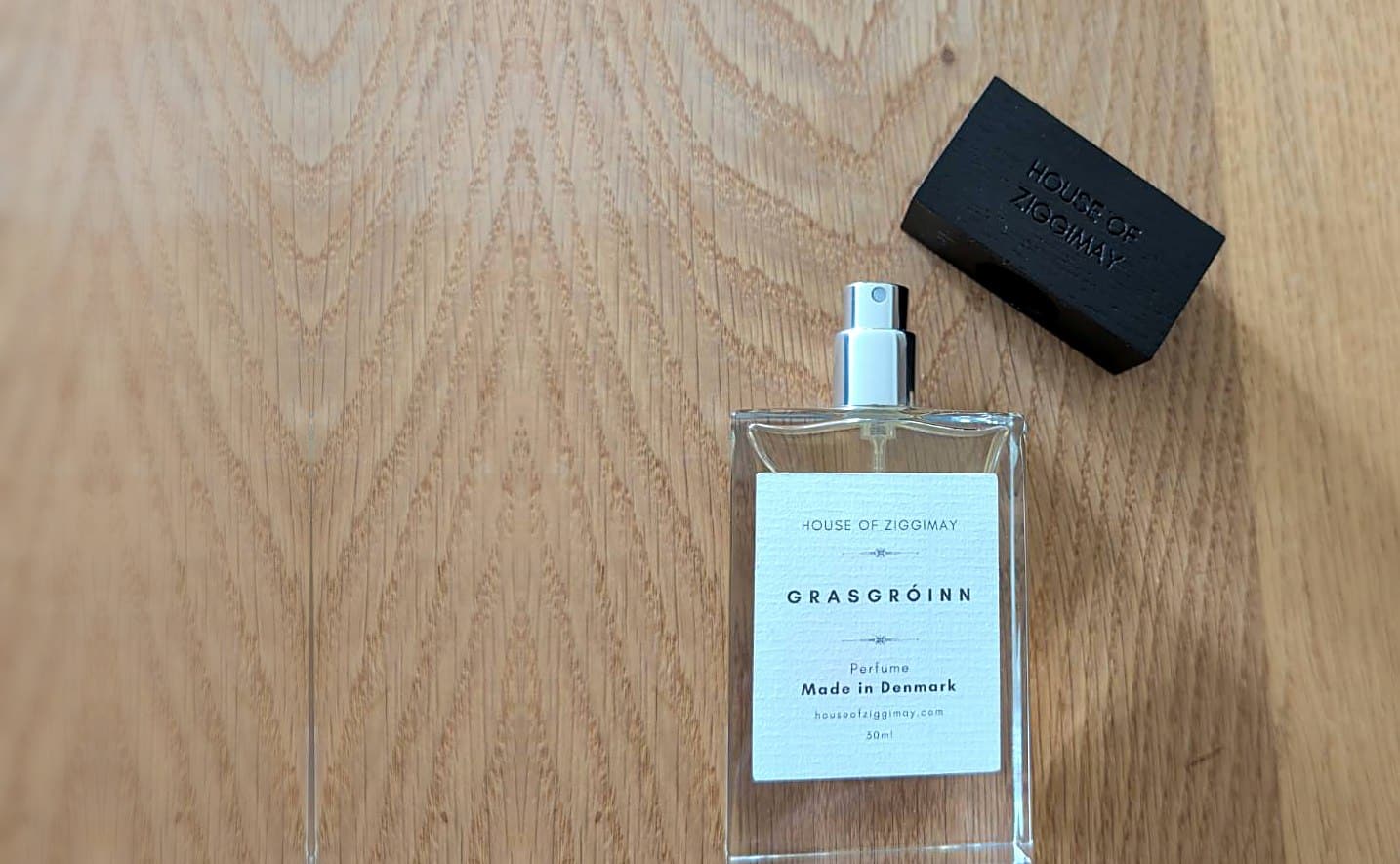
Grasgróinn is fairly typical of the approach: it opens on spice and cut grass, settles into ozone, jasmine and musk, and finishes on vanilla and soft wood. Green, but with warmth underneath rather than a clean fresh idea of outdoors.
What buying here is like in practice
Danish shops are generally not pushy, which is pleasant and can be unhelpful if you actually want guidance. You are expected to ask.
The useful questions are worth having ready. What is in it, in plain terms. What does it do after four hours. Can I take a sample away. A shop that answers the first two properly and says yes to the third is worth returning to.
Prices are high, and it is worth understanding why rather than assuming it is margin. Danish VAT is 25%, wages are high, and small production runs mean high unit costs. A fragrance made here is not competing with one made at volume elsewhere on price and is not trying to.
Where the market is going
Two things are visible.
The first is a move away from gendered marketing, which was never particularly strong here and is now largely gone. Most Danish houses simply do not label fragrances for men or women, and the compositions reflect that: fewer of the loud markers that traditionally signalled one or the other.
The second is sampling. Sample-first buying has become close to standard among the newer houses, partly because it is honest and partly because it is the only way to sell a fragrance online without a shop.
What it costs to make things here
Worth being direct about. Hand assembly, hand polished glass and fine mist atomisers all add cost, and none of them are visible in a photograph.
A house working this way has to accept a smaller range and a smaller customer base. The trade is that every fragrance has to justify itself, because there is no volume to hide a weak one in and no advertising budget to replace customers who do not come back.
That is the actual reason to look at small Danish houses, and it has nothing to do with national character.
Whether it suits you
If you want a fragrance people comment on from across a room, this is probably the wrong tradition. If you want something that reads at conversational distance and holds all day without becoming tiring, it is a reasonable place to look.
Either way it is not something to decide from a description. A day on your own skin settles it.
Where we sit in it
HOUSE OF ZIGGIMAY is a small part of exactly the pattern described above. Five fragrances rather than fifty, hand assembled in Denmark, priced by what the materials and the labour actually cost rather than by what the category will bear.
That is not a claim to be better than a large house. It is a different set of constraints: no advertising budget, no range to hide a weak release in, and word of mouth as the whole distribution strategy. Every bottle has to justify itself, which is why samples come with all of them.
Further reading: Buying niche perfume in Denmark, on finding a Danish stockist, testing properly, and what an import costs once it clears customs.