
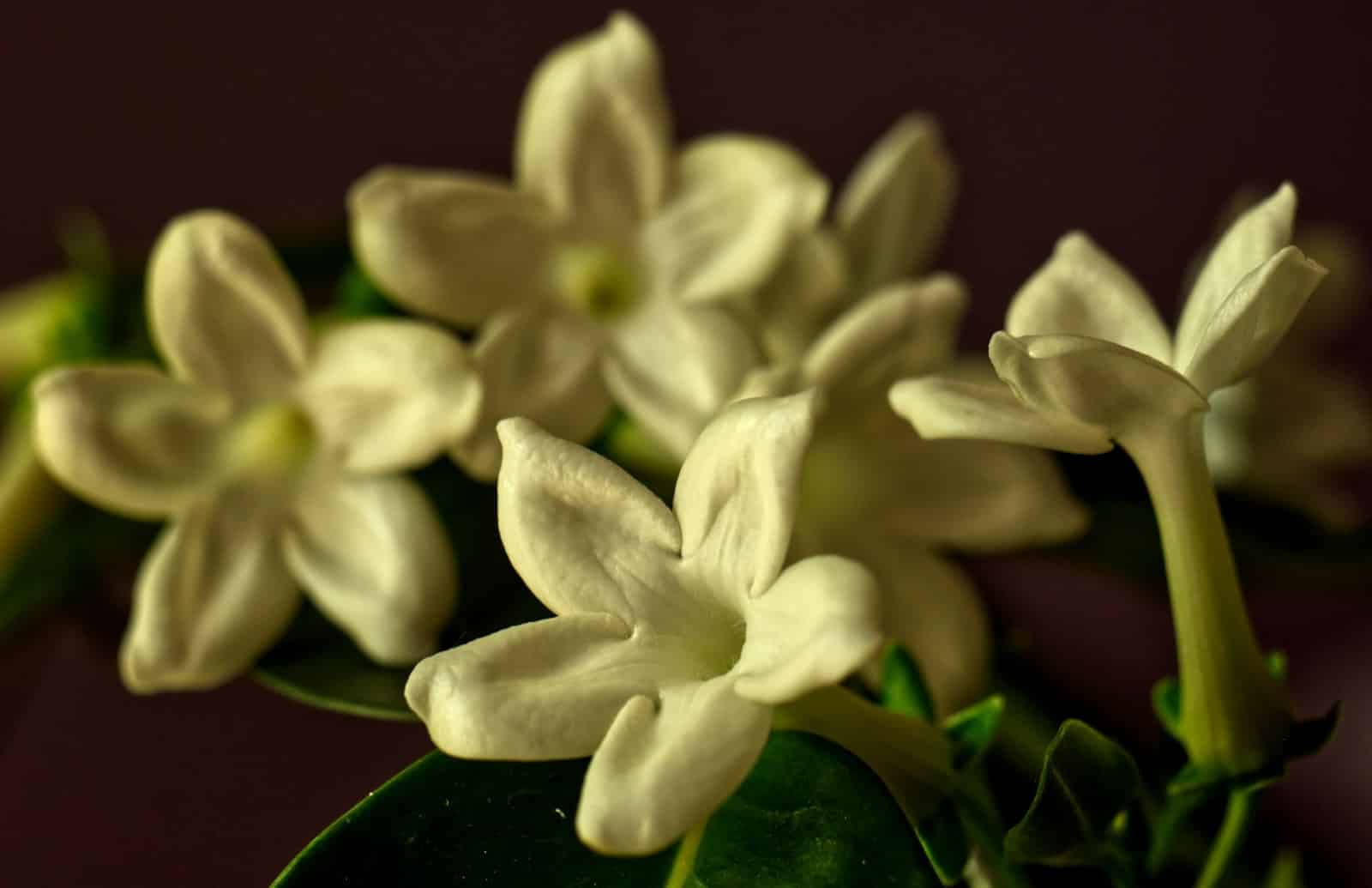
Jasmine is the flower perfumery uses most, and the real material surprises people. It is sweet, yes. It is also warm, heavy and faintly indecent, and that last part is the reason it matters.
Two flowers under one name
Perfumers work with two species. Jasminum grandiflorum is the classical one, grown in Grasse for centuries and today mostly in Egypt and India. It is rich, fruity and round. Jasminum sambac comes largely from India and is greener and sharper, with something of orange blossom in it. Sambac is the flower used to scent jasmine tea.
They are not interchangeable. A notes list that says “jasmine” is not telling you which one, or whether there is any flower in the bottle at all.
How it is taken from the flower
The blossoms open at night and are picked by hand around dawn, when they smell strongest. They bruise easily and begin to spoil within hours, so they go to extraction the same day.
Steam ruins them. Jasmine is washed with a solvent instead, which gives a waxy solid called a concrete, and the concrete is washed again with alcohol to give the absolute. It takes millions of flowers to make a single kilo. That is why the natural material is expensive, and why it is used in small amounts even by houses that can afford it.
The part nobody puts in the advertisement
Jasmine contains a molecule called indole. In high concentration indole smells of mothballs, and beyond that of something frankly animal. The same molecule occurs in decay.
In the flower it is present in a trace, and that trace is what makes jasmine smell alive instead of merely pretty. Take it out and you get a clean, pleasant, flat floral. Many modern jasmine notes are built exactly that way, for people who want the sweetness without the body. Neither version is wrong. They are different materials doing different jobs, and it helps to know which one you like.
What it does in a composition
Jasmine is a heart material. It arrives after the opening has cleared and stays for several hours.
Its real use is as a binder. It joins things that would otherwise sit apart: citrus above it, wood and musk below. A composition with a hole in the middle is very often a composition that needed jasmine. In small doses you do not smell a flower at all. You notice only that the fragrance feels round and finished.
It also softens. Sharp green notes, cold ozonic notes and dry woods all lose their edge beside it.
The synthetic that changed everything
In the 1960s chemists isolated a compound related to one found in jasmine and named it hedione. On its own it smells of very little: a faint, lemony, airy floral. In a composition it gives light and space, and makes everything around it seem to breathe.
It is now one of the most used materials in perfumery, in fragrances for men and women alike. If a modern perfume feels transparent and radiant, hedione is usually part of the reason. Most people have been wearing a piece of jasmine for years without being told.
How to tell which jasmine you are smelling
Wait an hour, then smell the skin closely.
A jasmine with natural absolute in it has depth and a slight warmth that is close to skin itself. A constructed jasmine stays bright and clean, and keeps the same character from start to finish. The first can be too much in heat. The second can be dull in winter.
Where it sits in what we make
Two of the five HOUSE OF ZIGGIMAY fragrances use jasmine in the heart, and in both it is there to soften. In Grasgróinn it takes the edge off the ozonic notes, so the clean part does not turn cold. In White Tea Del Mar it sits beside lavender, with a salt note running through both that keeps the result from becoming an ordinary floral.
Neither is a jasmine perfume. If you want the flower itself, loud and at the front, these are not the ones. If you want to find out what it does quietly, a sample of either will show you.