
Rose is the most expensive flower in perfumery and the most overused word in its marketing. Almost everything described as a rose fragrance contains no rose at all.
That is not necessarily a criticism. It is worth understanding why.
The arithmetic
It takes somewhere in the region of three to four tonnes of rose petals to produce a single kilogram of rose oil. The flowers have to be picked by hand, early, before the sun pulls the oil out of them, and the harvest lasts a few weeks a year.
That is why rose absolute is priced the way it is, and why a mass-market fragrance advertising rose is almost always using synthetics to suggest it.
Two roses, two smells
Perfumery uses two species, and they are not interchangeable.
Rosa damascena, the Damask rose, is the deeper one. Honeyed, slightly spiced, with a jammy quality in the heart. Most of what people picture when they think of rose perfume is this.
Rosa centifolia, the May rose, is lighter and greener, closer to the smell of the living flower in a garden than to rose in a bottle.
A perfumer choosing between them is choosing a temperature as much as a note.
Distillation against extraction
Steam distillation gives rose otto: clear, sharp, with a distinctive metallic brightness at the top. Solvent extraction gives rose absolute: darker, heavier, much closer to burying your face in the flower.
Neither is better. They are different materials with different jobs. Otto lifts a composition. Absolute anchors it.
What rose does to everything around it
Rose is unusual in that it improves the materials next to it. Put it with oud and it softens the animal edge without removing it. Put it with patchouli and it stops the earthiness turning dusty. Put it with citrus and it gives the top something to land on.
This is why rose appears in compositions that are not remotely about rose. It is often doing structural work rather than announcing itself.
Why so much rose smells wrong
Two reasons, usually.
The first is sweetness. Real rose is not sweet in the way rose-scented products are. It has a green, slightly bitter edge and a faint sourness. Remove those and you get something that smells like rose flavouring.
The second is flatness. Rose oil contains hundreds of compounds. Reconstructions built from a handful of the loudest ones smell like rose from a distance and like nothing much up close.
Rose and oud
The most durable pairing in perfumery, and worth understanding because it explains what rose is for.
Oud alone is dense and slightly animal, and for many people it is too much on its own. Rose does two things to it. The sweetness softens the animal edge without removing it, and the green, slightly sour quality underneath stops the whole thing turning syrupy.
The combination has been made in the Middle East for centuries and reached Western perfumery relatively recently. It works because the two materials are doing opposite jobs: one is pulling the composition down and inwards, the other is lifting it.
Where rose goes wrong on skin
Rose is one of the materials most affected by skin chemistry, which is why opinions on any given rose fragrance vary so widely.
On warmer skin it pushes forward and the jammy quality dominates, sometimes to the point of smelling like preserve. On cooler skin the green and metallic aspects survive longer and it reads considerably drier.
This is not a small variation. The same fragrance can be a soft powdery rose on one person and a sharp green one on another, and neither is wrong.
How to test a rose fragrance properly
Give it four hours minimum before deciding. Rose fragrances change more between hour one and hour four than almost anything else, largely because the top of a rose composition is usually built to be immediately pleasant and the base is where the character sits.
Test one at a time. Rose is loud enough that it will colour anything you smell after it, and testing two roses in an afternoon is a waste of both.
And test it on a day when you are not deciding. Rose is a material people have strong prior feelings about, and it is worth separating what you smell from what you expected to smell.
Deciding for yourself
Rose divides people more than almost any material, and the division usually comes down to what they have smelled before rather than the flower itself. Someone who dislikes rose perfume often turns out to dislike one specific commercial interpretation of it.
The only way through that is to wear a proper one for a day. A sample on skin will tell you in an afternoon what a shelf of descriptions cannot.
Rose in this range
Rose does not lead any fragrance at HOUSE OF ZIGGIMAY, which is a deliberate omission rather than an oversight. It is a material that divides people more sharply than almost any other, and a five fragrance range has no room for something half the audience will politely decline.
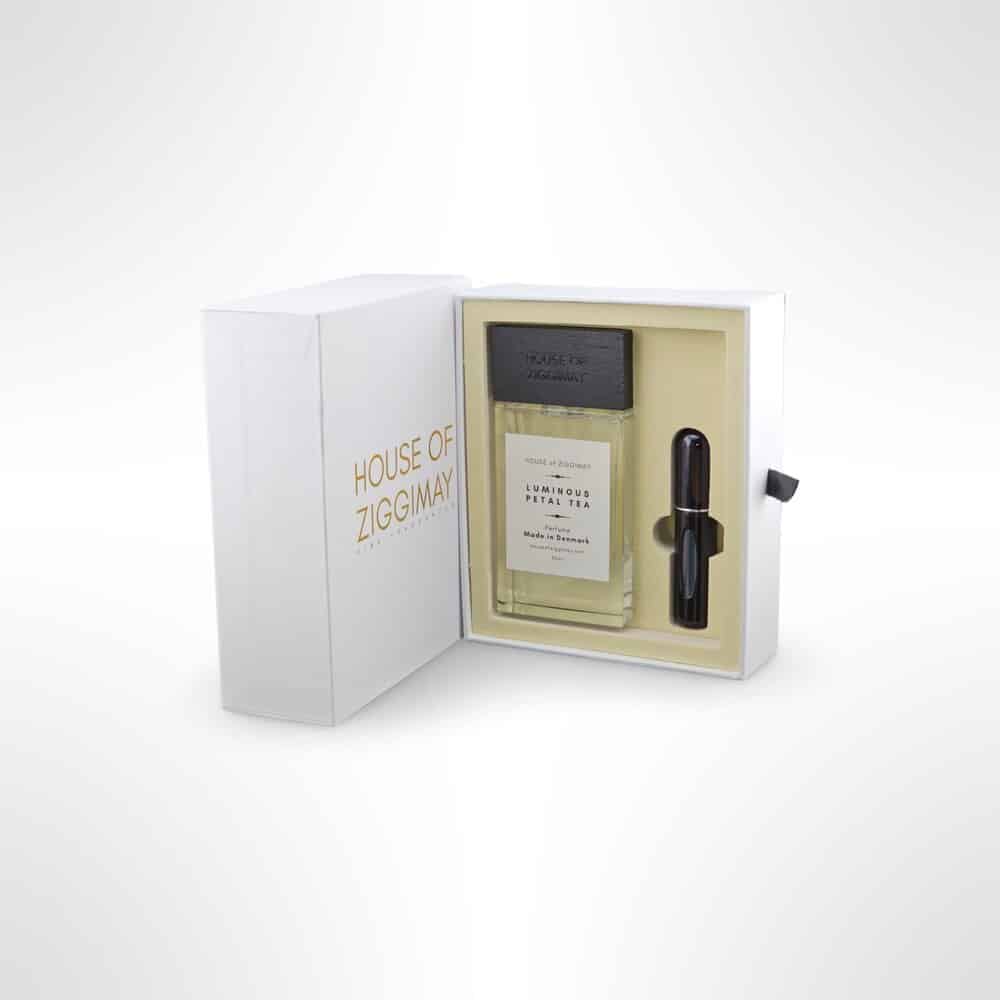
What the range does have is the structural idea behind rose: something green and slightly bitter placed under a sweeter note to stop it turning to syrup. Luminous Petal Tea works on that principle, with tea leaf doing the job rose would do elsewhere.