
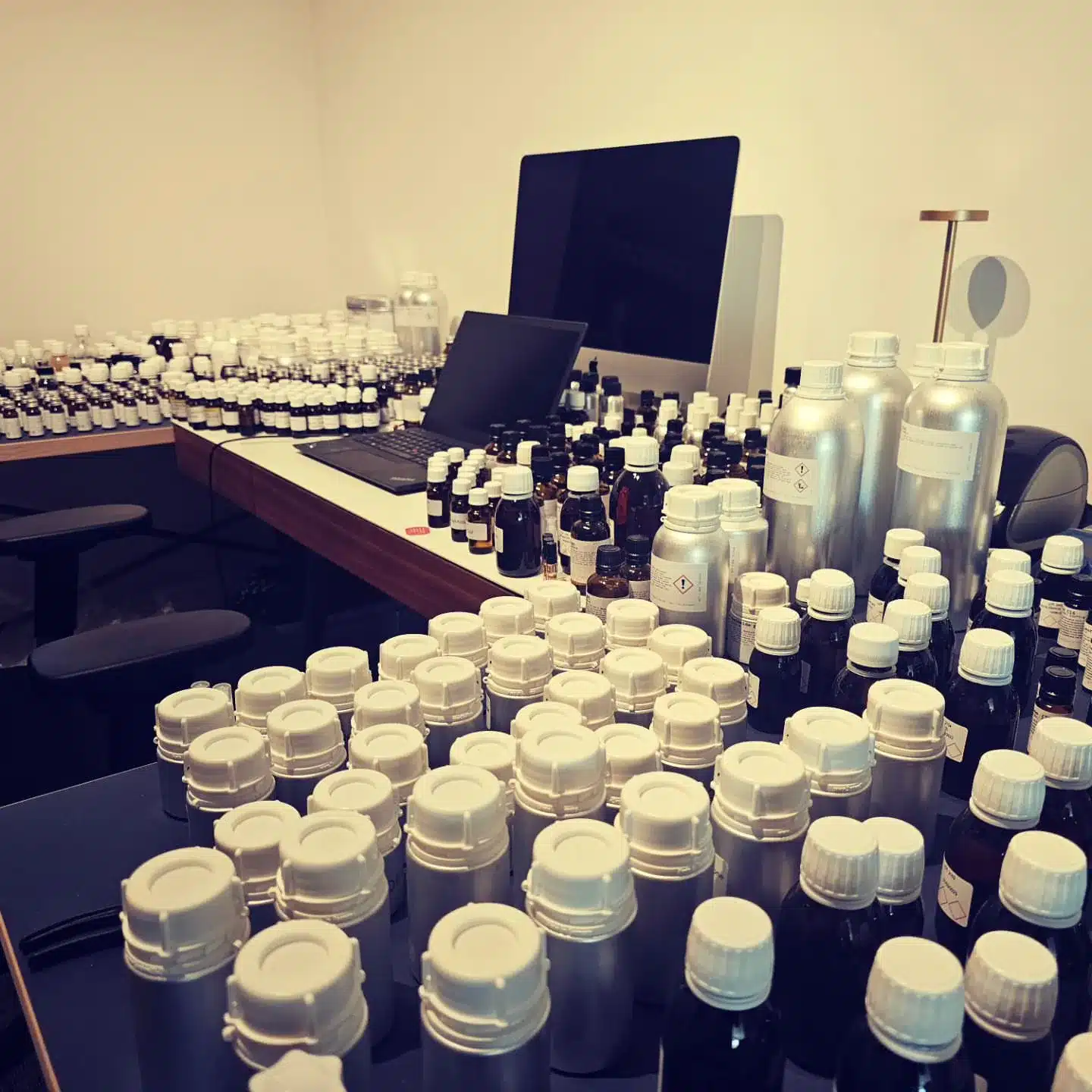
Perfumery is a manufacturing process with an unusual amount of judgement in it. The chemistry is not especially exotic. What takes time is deciding what to leave out.
Getting the materials
Naturals come out of plants by three main routes.
Steam distillation is the oldest and still the most common. Steam passes through plant material, the volatile oils travel with it, and the two separate on cooling. It works for lavender, most citrus peels, many woods.
Solvent extraction is used for flowers too delicate to survive heat. Jasmine and tuberose would be destroyed by steam. A solvent dissolves the aromatic compounds instead, and what is left after the solvent is removed is an absolute: heavier, closer to the living flower.
Expression is simply pressing. Citrus peel gives up its oil under pressure without any heat at all, which is why expressed citrus smells brighter than distilled.
Synthetics come from a laboratory, and the reflex to distrust them is misplaced. Many are molecules that also occur in nature, made more cleanly and more consistently. Some make fragrances possible that no plant could supply. And some materials are only available synthetically because harvesting the natural source would be indefensible.
Building the formula
A composition is written in three registers.
Top notes are the volatile materials you meet first and lose within about fifteen minutes. Heart notes carry the middle hours and hold the character. Base notes are the slow, heavy materials that fix everything else in place and are still there the next morning.
The craft is not in choosing good materials. It is in proportion. A base that is too strong swallows the heart. A top that is too bright makes everything after it feel like a disappointment.
Maceration, the part nobody sees
Once the concentrate is blended with alcohol, it has to sit. During maceration the materials react with each other and with the alcohol, edges come off, and the composition settles into what it will actually be.
Rushed, a fragrance smells like its ingredients standing next to each other. Given weeks, it smells like one thing.
This is one of the quiet places where cost gets cut, because time is expensive and nobody can see it in the bottle.
Concentration
The labels describe how much aromatic concentrate is in the alcohol. Eau de toilette sits lower, eau de parfum higher, extrait higher again.
Higher is not automatically better. It means denser and longer lasting, but it also means less room for the composition to open out. Some fragrances are better at lower concentration because they need the air.
The last details
The atomiser matters more than it sounds. A fine mist distributes a small amount evenly. A coarse spray puts too much in one place and distorts the opening for the first half hour.
Glass matters for storage rather than looks. Light and heat degrade a fragrance faster than anything else. A bottle on a sunny windowsill will be noticeably different within a year.
Why the same formula smells different on two people
Skin temperature is the largest factor. Warmer skin speeds evaporation, which pushes the fragrance forward, makes it louder early and shortens the whole arc. Cooler skin holds it back and stretches it out.
Skin pH and oil content matter too. Oilier skin holds aromatic materials longer, which is why the same fragrance often lasts noticeably longer on some people. Dry skin releases it faster and can make a composition seem thin when it is not.
Diet, medication and hormonal changes all shift this as well, which is why a fragrance you wore happily for years can suddenly seem wrong. Usually nothing has changed in the bottle.
Storage, and what actually ruins a fragrance
Light first, heat second, air third.
Ultraviolet light breaks down aromatic compounds directly, which is why fragrance is sold in coloured or boxed glass and why a bottle kept on a windowsill will be measurably duller within a year. A bathroom is the worst common storage place, because it combines heat with humidity and repeated temperature swings.
Air matters as the bottle empties. A nearly empty bottle has a large volume of air above the liquid, and oxidation gradually changes the top notes. This is why the last quarter of a bottle often smells slightly different from the first.
A drawer or a cupboard at room temperature is entirely sufficient. Refrigeration is unnecessary and the repeated temperature change on taking it in and out does more harm than good.
Shelf life
An unopened bottle stored properly will keep for years. An opened one is at its best for roughly two to three, and after that the top notes go first while the base stays largely intact. The result is a fragrance that seems to start in the middle.
This is a reason not to stockpile. Buying three bottles of something you love means the third will not be quite what the first was.
What none of this tells you
Everything above is process, and process does not predict whether you will like something. A fragrance made carefully from good materials can still be wrong on your skin.
That is why HOUSE OF ZIGGIMAY sends two 1.5 ml samples with every bottle, chosen by you at checkout. Wear one for a full day before you decide anything.