
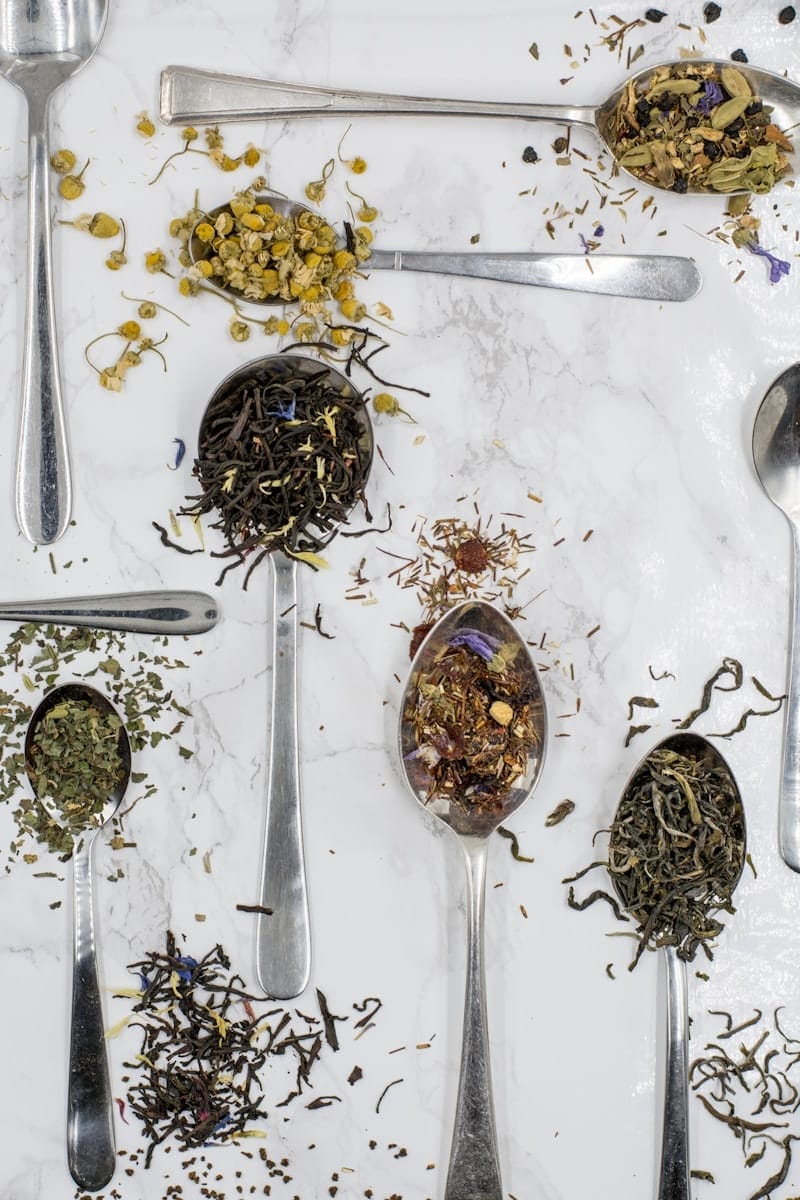
There is rarely any tea in a tea fragrance. The note is nearly always built from other materials, and once you know which ones, tea perfumes become much easier to choose between.
Why the leaf itself is seldom used
Extracts of real tea exist. Black tea absolute and green tea absolute are both made, and both are disappointing if you expect the smell of a fresh cup. They are dark and dry, closer to hay and tobacco than to anything you would drink. The bright part of tea, the part that rises with the steam, does not survive extraction well.
So perfumers do what they do with lily of the valley and with the sea. They build the impression from materials that do hold.
What a tea note is made of
The exact recipe differs with every perfumer, but the same few ideas come back.
Something green and leafy. A cut grass material gives the fresh, wet leaf.
Something airy. Hedione, a relative of a compound in jasmine, supplies the feeling of steam and space.
Something dry. Violet and iris type materials, or a little hay, give the faint astringency that makes tea feel like tea instead of like a herb garden.
Citrus on top. Almost always bergamot.
Real tea absolute is sometimes added in a small amount for depth. It is the seasoning, not the dish.
Why bergamot keeps turning up
Earl Grey is black tea scented with bergamot oil. Generations of people have learned that combination from a cup, so bergamot over anything dry and leafy reads instantly as tea. Perfumers lean on that association, in the same way clean fragrances lean on the smell of laundry.
It is a learned link. It also works every time.
Green, black, white
The three names describe three different constructions.
Green tea is the freshest and the most common. Leafy, slightly bitter, lemony, with a great deal of air in it. It suits heat and can feel thin in winter.
Black tea is warmer and drier. Often smoky, sometimes with a leather or tobacco edge, and frequently paired with bergamot or spice. It has more weight and lasts longer.
White tea is the softest. In the cup it is the least processed kind of tea and tastes of very little, so in perfume the phrase is closer to a mood than a material: pale, clean, lightly floral, usually resting on musk. If a white tea fragrance smells mostly of soft musk, nothing has gone wrong. That is what the name tends to mean.
What tea fragrances are good at, and where they fail
They are calm. A tea note gives a composition a quiet, dry centre that most florals and fruits cannot, and it wears well on people who dislike sweetness.
The weakness is the other side of the same quality. The materials that make the impression are light, so a tea fragrance with nothing underneath is gone by lunch. The good ones put something slow in the base, moss or wood or musk, and let the tea rest on it. When you test one, the opening tells you whether you like the idea. Hour three tells you whether it was built properly.
Where ours sit
Two HOUSE OF ZIGGIMAY fragrances are built around tea, and they take opposite routes.
Luminous Petal Tea is the Earl Grey one. Herbs and citrus open it, which is the bergamot over leaves part, with herbal spice and a soft musk in the middle so the tea has something to sit on. The base is vanilla and wood over moss. The moss is what keeps it from reading sweet.
White Tea Del Mar is the pale one: white tea, citrus and flowers over green, cool where the other is warm, with a sea breeze note in the heart. It is the one for warm weather.
They are different enough that liking one says little about the other. Both are in the Discovery Box, and each is sold as a single sample.